

Contrastive ESA: Human Evaluation of Multiple Translations at Once

Current human evaluation of machine translation typically assesses single outputs in isolation, a paradigm that suffers from high annotator noise and cost. We introduce Contrastive Error Span Annotation (cESA), a protocol that presents multiple translations of the source input (text, video, audio, image). In cESA, the annotator sees multiple translations of the same document, marks #major and #minor error spans, and then assigns a score from 0% to 100% on absolute scale. By allowing annotators to access the shared context across multiple outputs, cESA facilitates more consistent and efficient judgments. We validate cESA using a large-scale human evaluation of English$arrow$Japanese translations of 12 models, demonstrating reductions in annotation time and noise compared to standard pointwise evaluation. Unlike existing contrastive ranking methods, cESA yields absolute quality judgments that enable simple, interpretable non-parametric model rankings without the need for post-hoc corrections.
Dynamically Allocating Evaluation Effort for Model Ranking

While human evaluation is the gold standard in many NLP tasks, it suffers from prohibitive costs and poor scalability. When identifying top-performing models, typical evaluation protocols waste effort by exhaustively evaluating all models on the entire benchmark, a safe but inefficient approach. In this work, we formalize multi-model human evaluation as a best-arm identification problem in a multi-armed bandit setup with correlated arms, where pulling an arm corresponds to human-evaluating a model. By sampling adaptively based on the intermediate model rankings obtained on the samples so far, we can focus the annotation budget on the most competitive models. We prove the optimality of the proposed algorithms and show that it improves discrimination between top-performing models. This makes evaluations faster, cheaper and more aligned with large-scale competition evaluation goals.
🍐 Pearmut: Human Evaluation of Translation Made Trivial

Human evaluation is the gold standard for multilingual NLP, but is often skipped in practice and substituted with automatic metrics, because it is notoriously complex and slow to set up with existing tools with substantial engineering and operational overhead. We introduce Pearmut, a lightweight yet feature-rich platform that makes end-to-end human evaluation as easy to run as automatic evaluation. Pearmut removes common entry barriers and provides support for evaluating multilingual tasks, with a particular focus on machine translation. The platform implements standard evaluation protocols, including DA, ESA, or MQM, but is also extensible to allow prototyping new protocols. It features document-level context, absolute and contrastive evaluation, attention checks, ESAAI pre-annotations and both static and active learning-based assignment strategies. Pearmut enables reliable human evaluation to become a practical, routine component of model development and diagnosis rather than an occasional effort.
Last Translation Benchmark

For scientific progress, we need benchmarks that test the limits of state-of-the-art models, and evaluation methods that inform us about failure cases. As models get stronger, standard benchmarks for machine translation are approaching saturation. Further, automatic translation metrics are unreliable, vulnerable to reward-hacking, and provide unactionable assessments. Even gold human evaluation is not problem-free, because it often lacks reproducibility, objectivity, and scalability. Overall, this prevents us from tracking objective progress in the field and identifying pathways for improvement. We introduce the Last Translation Benchmark, a collection of human-authored and peer-reviewed examples (texts, images, audio, videos) that break leading machine translation models. We also present a new evaluation approach: each example comes with handcrafted verification rules describing concrete failure cases on that example, therefore allowing reliable and actionable future evaluation. The Last Translation Benchmark is a live dataset that accepts ongoing contributions. The latest version is LTBv1, containing accepted contributions prior to September 1st 2026, with future releases planned as new data is continuously collected.
How to Select Datapoints for Efficient Human Evaluation of NLG Models?

Human evaluation is the gold-standard for evaluating text generation models. It is also expensive, and to fit budgetary constraints, a random subset of the test data is often chosen in practice. The randomly selected data may not accurately represent test performance, making this approach economically inefficient for model comparison. Thus, in this work, we develop a suite of selectors to get the most informative datapoints for human evaluation while taking the evaluation costs into account. We show that selectors based on variance in automated metric scores, diversity in model outputs, or Item Response Theory outperform random selection. We further develop an approach to distill these selectors to the scenario where the model outputs are not yet available. In particular, we introduce source-based estimators, which predict item usefulness for human evaluation just based on the source texts. We demonstrate the efficacy of our selectors in two common NLG tasks, machine translation and summarization, and show that up to only ~50% of the test data is needed to produce the same evaluation result as the entire data. Our implementations are published in the subset2evaluate package.
Estimating Machine Translation Difficulty

Machine translation quality has began achieving near-perfect translations in some setups. These high-quality outputs make it difficult to distinguish between state-of-the-art models and to identify areas for future improvement. Automatically identifying texts where machine translation systems struggle holds promise for developing more discriminative evaluations and guiding future research. We formalize the task of translation difficulty estimation, defining a text's difficulty based on the expected quality of its translations. We introduce a new metric to evaluate difficulty estimators and use it to assess both baselines and novel approaches. Finally, we demonstrate the practical utility of difficulty estimators by using them to construct more challenging machine translation benchmarks. Our results show that dedicated models (dubbed Sentinel-src) outperform both heuristic-based methods (e.g. word rarity or syntactic complexity) and LLM-as-a-judge approaches. We release two improved models for difficulty estimation, Sentinel-src-24 and Sentinel-src-25, which can be used to scan large collections of texts and select those most likely to challenge contemporary machine translation systems.
Early-Exit and Instant Confidence Translation Quality Estimation

Quality estimation is omnipresent in machine translation, for both evaluation and generation. Unfortunately, quality estimation models are often opaque and computationally expensive, making them impractical to be part of large-scale pipelines. In this work, we tackle two connected challenges: (1) reducing the cost of quality estimation at scale, and (2) developing an inexpensive uncertainty estimation method for quality estimation. To address the latter, we introduce Instant Confidence COMET, an uncertainty-aware quality estimation model that matches the performance of previous approaches at a fraction of their costs. We extend this to Early-Exit COMET, a quality estimation model that can compute quality scores and associated confidences already at early model layers, allowing us to early-exit computations and reduce evaluation costs. We also apply our model to machine translation reranking. We combine Early-Exit COMET with an upper confidence bound bandit algorithm to find the best candidate from a large pool without having to run the full evaluation model on all candidates. In both cases (evaluation and reranking) our methods reduce the required compute by 50% with very little degradation in performance.
Generating Difficult-to-Translate Texts

Machine translation benchmarks sourced from the real world are quickly obsoleted, due to most examples being easy for state-of-the-art translation models. This limits the benchmark's ability to distinguish which model is better or to reveal models' weaknesses. Current methods for creating difficult test cases, such as subsampling or from-scratch synthesis, either fall short of identifying difficult examples or suffer from a lack of diversity and naturalness. Inspired by the iterative process of human experts probing for model failures, we propose MT-breaker, a method where a large language model iteratively refines a source text to increase its translation difficulty. The LLM iteratively queries a target machine translation model to guide its generation of difficult examples. Our approach generates examples that are more challenging for the target MT model while preserving the diversity of natural texts. While the examples are tailored to a particular machine translation model during the generation, the difficulty also transfers to other models and languages.
Searching for Difficult-to-Translate Test Examples at Scale

NLP models require test data that are sufficiently challenging. The difficulty of an example is linked to the topic it originates from (''seed topic''). The relationship between the topic and the difficulty of its instances is stochastic in nature: an example about a difficult topic can happen to be easy, and vice versa. At the scale of the Internet, there are tens of thousands of potential topics, and finding the most difficult one by drawing and evaluating a large number of examples across all topics is computationally infeasible. We formalize this task and treat it as a multi-armed bandit problem. In this framework, each topic is an ''arm,'' and pulling an arm (at a cost) involves drawing a single example, evaluating it, and measuring its difficulty. The goal is to efficiently identify the most difficult topics within a fixed computational budget. We illustrate the bandit problem setup of finding difficult examples for the task of machine translation. We find that various bandit strategies vastly outperform baseline methods like brute-force searching the most challenging topics.
AI-Assisted Human Evaluation of Machine Translation
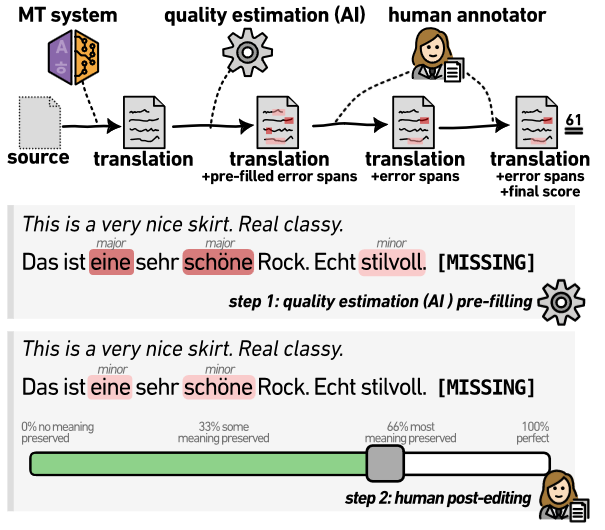
Annually, research teams spend large amounts of money to evaluate the quality of machine translation systems (WMT, inter alia). This is expensive because it requires detailed human labor. The recently proposed annotation protocol, Error Span Annotation (ESA), has annotators marking erroneous parts of the translation. In our work, we help the annotators by pre-filling the span annotations with automatic quality estimation. With AI assistance, we obtain more detailed annotations while cutting down the time per span annotation by half (71s/error span → 31s/error span). The biggest advantage of ESAAI protocol is an accurate priming of annotators (pre-filled error spans) before they assign the final score as opposed to starting from scratch. In addition, the annotation budget can be reduced by up to 24% with filtering of examples that the AI deems to be very likely to be correct.
Pitfalls and Outlooks in Using COMET
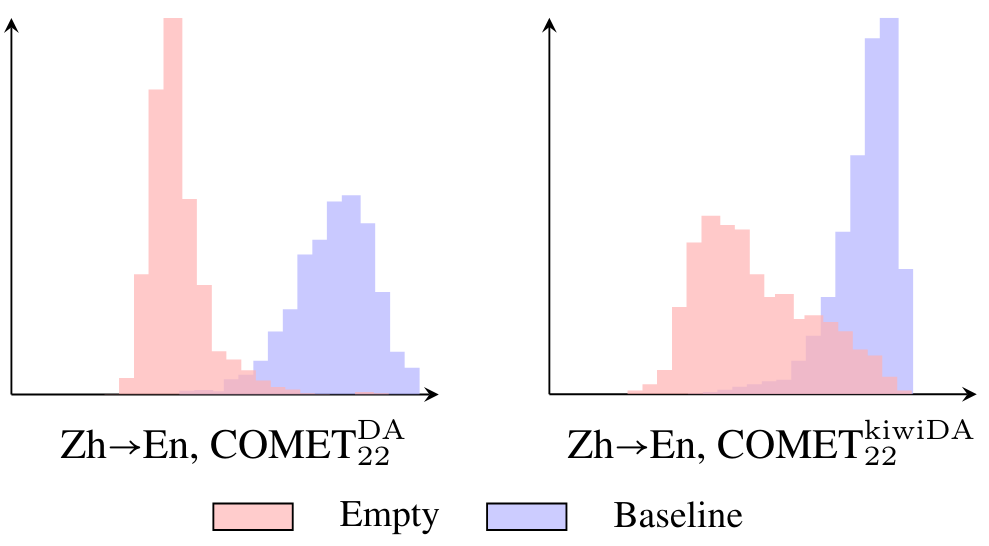
Since its introduction, the COMET metric has blazed a trail in the machine translation community, given its strong correlation with human judgements of translation quality. Its success stems from being a modified pre-trained multilingual model finetuned for quality assessment. However, it being a machine learning model also gives rise to a new set of pitfalls that may not be widely known. We investigate these unexpected behaviours from three aspects: 1) technical: obsolete software versions and compute precision; 2) data: empty content, language mismatch, and translationese at test time as well as distribution and domain biases in training; 3) usage and reporting: multi-reference support and model referencing in the literature. All of these problems imply that COMET scores is not comparable between papers or even technical setups and we put forward our perspective on fixing each issue. Furthermore, we release the SacreCOMET package that can generate a signature for the software and model configuration as well as an appropriate citation. The goal of this work is to help the community make more sound use of the COMET metric.
Error Span Annotation: A Balanced Approach for Human Evaluation of Machine Translation
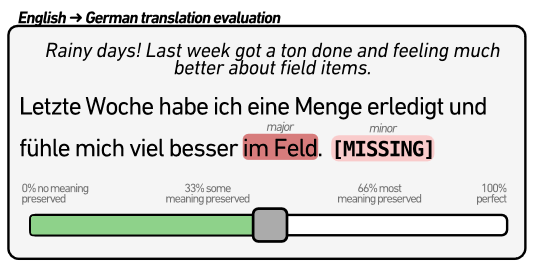
High-quality Machine Translation (MT) evaluation relies heavily on human judgments. Comprehensive error classification methods, such as Multidimensional Quality Metrics (MQM), are expensive as they are time-consuming and can only be done by experts, whose availability may be limited especially for low-resource languages. On the other hand, just assigning overall scores, like Direct Assessment (DA), is simpler and faster and can be done by translators of any level, but are less reliable. In this paper, we introduce Error Span Annotation (ESA), a human evaluation protocol which combines the continuous rating of DA with the high-level error severity span marking of MQM. We validate ESA by comparing it to MQM and DA for 12 MT systems and one human reference translation (English to German) from WMT23. The results show that ESA offers faster and cheaper annotations than MQM at the same quality level, without the requirement of expensive MQM experts.
Fine-Tuned Machine Translation Metrics Struggle in Unseen Domains
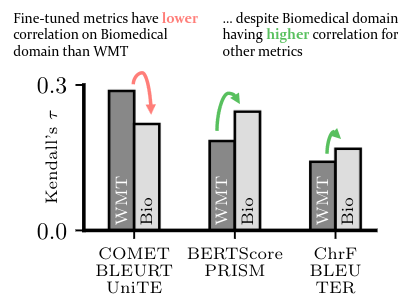
We introduce a new, extensive multidimensional quality metrics (MQM) annotated dataset covering 11 language pairs in the biomedical domain. We use this dataset to investigate whether machine translation (MT) metrics which are fine-tuned on human-generated MT quality judgements are robust to domain shifts between training and inference. We find that fine-tuned metrics exhibit a substantial performance drop in the unseen domain scenario relative to metrics that rely on the surface form, as well as pre-trained metrics which are not fine-tuned on MT quality judgments.
Navigating the Metrics Maze: Reconciling Score Magnitudes and Accuracies
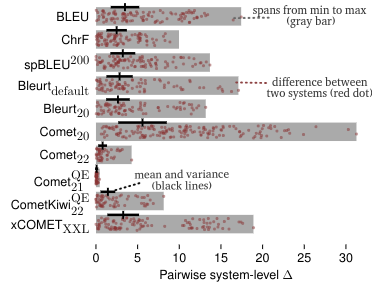
Ten years ago a single metric, BLEU, governed progress in machine translation research. For better or worse, there is no such consensus today, and consequently it is difficult for researchers to develop and retain the kinds of heuristic intuitions about metric deltas that drove earlier research and deployment decisions. This paper investigates the 'dynamic range' of a number of modern metrics in an effort to provide a collective understanding of the meaning of differences in scores both within and among metrics; in other words, we ask what point difference X in metric Y is required between two systems for humans to notice? We conduct our evaluation on a new large dataset, ToShip23, using it to discover deltas at which metrics achieve system-level differences that are meaningful to humans, which we measure by pairwise system accuracy. We additionally show that this method of establishing delta-accuracy is more stable than the standard use of statistical p-values in regards to testset size. Where data size permits, we also explore the effect of metric deltas and accuracy across finer-grained features such as translation direction, domain, and system closeness.
RELIC: Investigating Large Language Model Responses using Self-Consistency
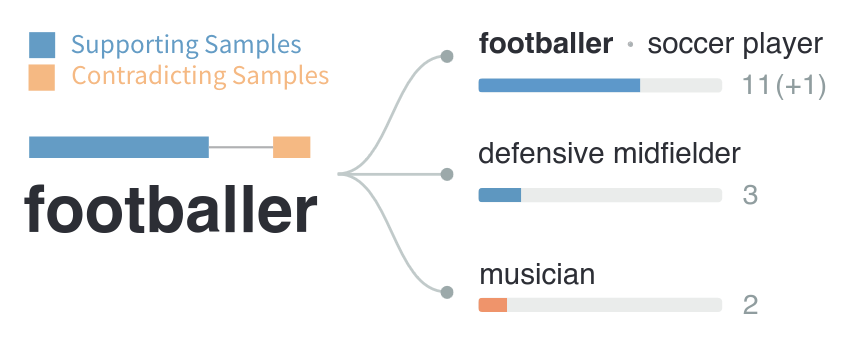
Large Language Models (LLMs) are notorious for blending fact with fiction and generating non-factual content, known as hallucinations. To tackle this challenge, we propose an interactive system that helps users obtain insights into the reliability of the generated text. Our approach is based on the idea that the self-consistency of multiple samples generated by the same LLM relates to its confidence in individual claims in the generated texts. Using this idea, we design RELIC, an interactive system that enables users to investigate and verify semantic-level variations in multiple long-form responses. This allows users to recognize potentially inaccurate information in the generated text and make necessary corrections. From a user study with ten participants, we demonstrate that our approach helps users better verify the reliability of the generated text. We further summarize the design implications and lessons learned from this research for inspiring future studies on reliable human-LLM interactions.
Distributional Properties of Subword Regularization
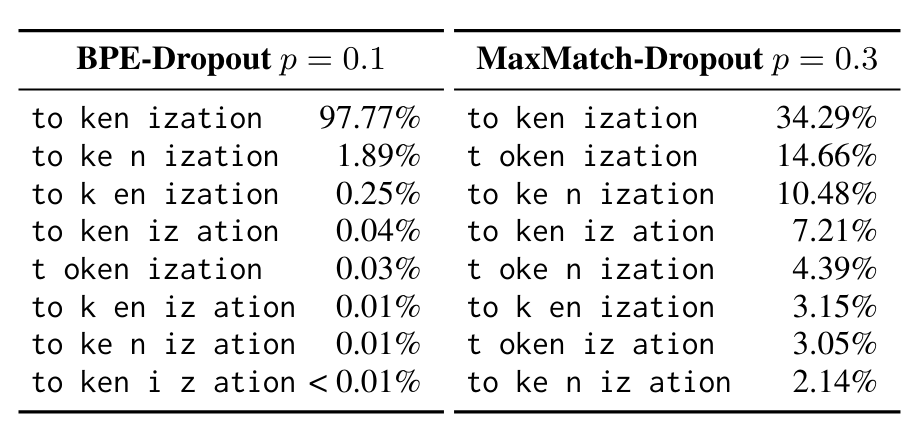
Subword regularization, used widely in NLP, improves model performance by reducing the dependency on exact tokenizations, augmenting the training corpus, and exposing the model to more unique contexts during training. BPE and MaxMatch, two popular subword tokenization schemes, have stochastic dropout regularization variants. However, there has not been an analysis of the distributions formed by them. We show that these stochastic variants are heavily biased towards a small set of tokenizations per word. If the benefits of subword regularization are as mentioned, we hypothesize that biasedness artificially limits the effectiveness of these schemes. Thus, we propose an algorithm to uniformly sample tokenizations that we use as a drop-in replacement for the stochastic aspects of existing tokenizers, and find that it improves machine translation quality.
Evaluating Optimal Reference Translations
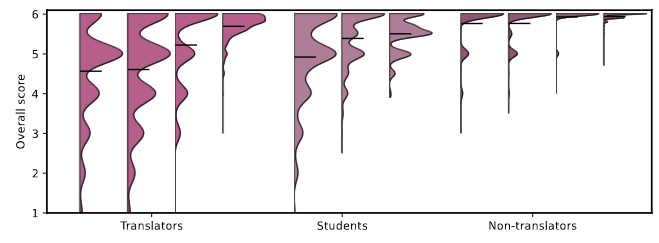
The overall translation quality reached by current machine translation (MT) systems for high-resourced language pairs is remarkably good. Standard methods of evaluation are not suitable nor intended to uncover the many translation errors and quality deficiencies that still persist. Furthermore, the quality of standard reference translations is commonly questioned and comparable quality levels have been reached by MT alone in several language pairs. Navigating further research in these high-resource settings is thus difficult. In this article, we propose a methodology for creating more reliable document-level human reference translations, called 'optimal reference translations,' with the simple aim to raise the bar of what should be deemed 'human translation quality.' We evaluate the obtained document-level optimal reference translations in comparison with 'standard' ones, confirming a significant quality increase and also documenting the relationship between evaluation and translation editing.
A Diachronic Perspective on User Trust in AI under Uncertainty
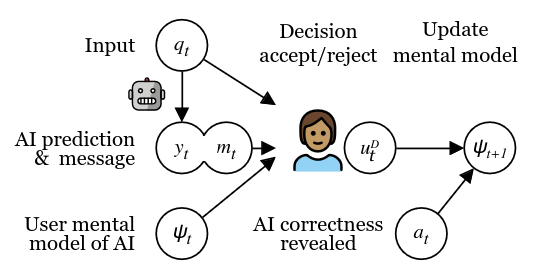
In human-AI collaboration, users typically form a mental model of the AI system, which captures the user’s beliefs about when the system performs well and when it does not. The construction of this mental model is guided by both the system’s veracity as well as the system output presented to the user e.g., the system’s confidence and an explanation for the prediction. However, modern NLP systems are seldom calibrated and are often confidently incorrect about their predictions, which violates users’ mental model and erodes their trust. In this work, we design a study where users bet on the correctness of an NLP system, and use it to study the evolution of user trust as a response to these trust-eroding events and how the user trust is rebuilt as a function of time after these events. We find that even a few highly inaccurate confidence estimation instances are enough to damage users’ trust in the system and performance, which does not easily recover over time. We further find that users are more forgiving to the NLP system if it is unconfidently correct rather than confidently incorrect, even though, from a game-theoretic perspective, their payoff is equivalent. Finally, we find that each user can entertain multiple mental models of the system based on the type of the question. These results highlight the importance of confidence calibration in developing user-centered NLP applications to avoid damaging user trust and compromising the collaboration performance.
Tokenization and the Noiseless Channel
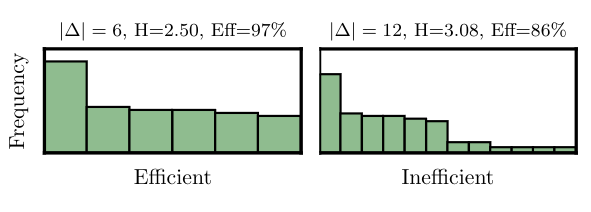
Subword tokenization is a key part of most NLP pipelines. However, little is known about why some tokenizer and hyperparameter combinations lead to improved downstream model performance over others. We propose that good tokenizers lead to efficient channel usage, where the channel is the means by which some input is conveyed to the model and efficiency can be quantified in information-theoretic terms as the ratio of the Shannon entropy to the maximum entropy of the subword distribution. Nevertheless, an optimal encoding according to Shannon entropy assigns extremely long codes to low-frequency subwords and very short codes to high-frequency subwords.Defining efficiency in terms of Rényi entropy, on the other hand, penalizes distributions with either very high or very low-frequency subwords.We posit that (1) extremely high-frequency subwords are problematic because their meaning is not distinct and (2) that low-frequency subwords may not appear frequently enough for their meaning to be learned properly; encodings that induce unigram distributions with either can harm model performance. In machine translation, we find that across multiple tokenizers, the Rényi entropy has a very strong correlation with BLEU: 0.82 in comparison to just -0.30 for compressed length.
A Formal Perspective on Byte-Pair Encoding
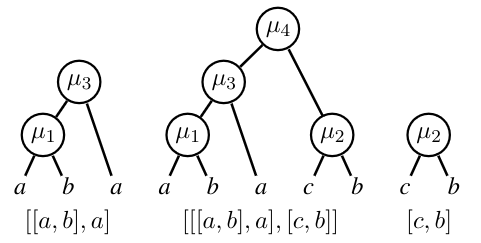
Byte-Pair Encoding (BPE) is a popular algorithm used for tokenizing data in NLP, despite being devised initially as a compression method. BPE appears to be a greedy algorithm at face value, but the underlying optimization problem that BPE seeks to solve has not yet been laid down. We formalize BPE as a combinatorial optimization problem. Via submodular functions, we prove that the iterative greedy version is a 1/sigma*(1-e(-sigma))-approximation of an optimal merge sequence, where sigma is the total backward curvature with respect to the optimal merge sequence. Empirically the lower bound of the approximation is ~0.37.We provide a faster implementation of BPE which improves the runtime complexity from O(NM) to O(N log M), where N is the sequence length and M is the merge count. Finally, we optimize the brute-force algorithm for optimal BPE using memoization.
Re-visiting Automated Topic Model Evaluation with Large Language Models
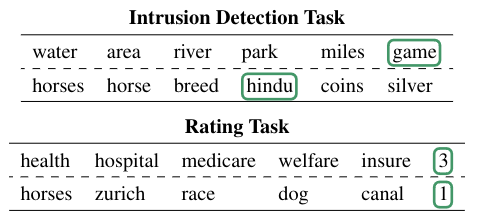
Topic models help us make sense of large text collections. Automatically evaluating their output and determining the optimal number of topics are both longstanding challenges, with no effective automated solutions to date. This paper proposes using large language models (LLMs) for these tasks. We find that LLMs appropriately assess the resulting topics, correlating more strongly with human judgments than existing automated metrics. However, the setup of the evaluation task is crucial — LLMs perform better on coherence ratings of word sets than on intrustion detection. We find that LLMs can also assist us in guiding us towards a reasonable number of topics. In actual applications, topic models are typically used to answer a research question related to a collection of texts. We can incorporate this research question in the prompt to the LLM, which helps estimating the optimal number of topics.
Poor Man's Quality Estimation: Predicting Ref.-Based MT Metrics Without Reference
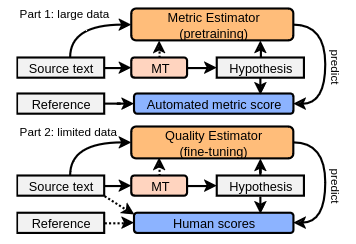
Machine translation quality estimation (QE) predicts human judgements of a translation hypothesis without seeing the reference. State-of-the-art QE systems based on pretrained language models have been achieving remarkable correlations with human judgements yet they are computationally heavy and require human annotations, which are slow and expensive to create. To address these limitations, we define the problem of metric estimation (ME) where one predicts the automated metric scores also without the reference. We show that even without access to the reference, our model can estimate automated metrics (ρ = 60% for BLEU, ρ = 51% for other metrics) at the sentence-level. Because automated metrics correlate with human judgements, we can leverage the ME task for pre-training a QE model. For the QE task, we find that pre-training on TER is better (ρ = 23%) than training for scratch (ρ = 20%).
Neural Machine Translation Quality and Post-Editing Performance
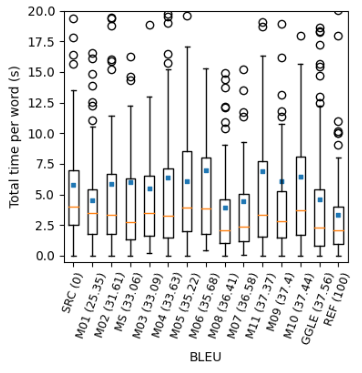
We test the natural expectation that using MT in professional translation saves human processing time. The last such study was carried out by Sanchez-Torron and Koehn (2016) with phrase-based MT, artificially reducing the translation quality. In contrast, we focus on neural MT (NMT) of high quality, which has become the state-of-the-art approach since then and also got adopted by most translation companies. Through an experimental study involving over 30 professional translators for English -> Czech translation, we examine the relationship between NMT performance and post-editing time and quality. Across all models, we found that better MT systems indeed lead to fewer changes in the sentences in this industry setting. The relation between system quality and post-editing time is however not straightforward and, contrary to the results on phrase-based MT, BLEU is definitely not a stable predictor of the time or final output quality.
Providing Backtranslation Improves Users Confidence in MT, Not Quality
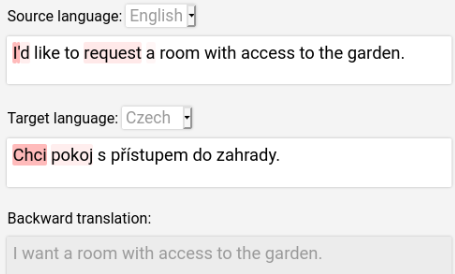
Translating text into a language unknown to the text’s author, dubbed outbound translation, is a modern need for which the user experience has significant room for improvement, beyond the basic machine translation facility. We demonstrate this by showing three ways in which user confidence in the outbound translation, as well as its overall final quality, can be affected: backward translation, quality estimation (with alignment) and source paraphrasing. In this paper, we describe an experiment on outbound translation from English to Czech and Estonian. We examine the effects of each proposed feedback module and further focus on how the quality of machine translation systems influence these findings and the user perception of success. We show that backward translation feedback has a mixed effect on the whole process: it increases user confidence in the produced translation, but not the objective quality.
Other projects and Shared Tasks
Apertus 1.5: From Open Text Models to Open Multimodal Reasoners
Language models are becoming infrastructure, and infrastructure built in the open, by public institutions, on documented data, is the alternative to dependence on a few providers; Apertus shows this is viable at scale. Apertus 1.5 extends the fully open Apertus family from text to multimodal reasoning. Continued pretraining of the Apertus 1.0 models, on 4T additional tokens for the 8B and 2T for the 70B, adds image and audio understanding and extends the context window fourfold to 262,144 tokens; multimodality enters through the tokenizer, the language-model head remains restricted to text, and the architecture is unchanged. Supervised finetuning, long-context finetuning, reinforcement learning with verifiable rewards, and preference alignment complete the released models. Thinking is a flag of the chat template rather than a separate model, and lifts mathematical reasoning by up to 20 points on the 8B model. The released models improve over their predecessors on nearly every benchmark; among fully open models of its class, the 8B leads on knowledge, instruction following, and cultural benchmarks, and its instruction following surpasses all compared models, including open-weight ones. On image and audio understanding, a first for the family, the models are competitive with fully open multimodal models, strongest on document understanding and long-form and lower-resource speech recognition, while specialized vision and audio models remain ahead on perception and transcription of English and other high-resource languages. As in Apertus 1.0, we train only on openly available data, respect crawler opt-outs retroactively, and exclude restrictively licensed material. We release the model weights, data preparation and training recipes, and evaluation suites under permissive licenses; openness extends to values, with the Apertus charter guiding alignment stages published alongside the models.
There is No Theoretical Curse of Multilinguality For Embedding Space Structure

A central goal of multilingual NLP is to achieve high monolingual performance per language and cross-lingual alignment for large-scale language coverage with a multilingual model. The curse of multilinguality describes the phenomenon of degradation in multilingual model performance as we increase language coverage, posing a threat to the above goal. This paper asks whether multilingual embedding spaces are inherently incapable of achieving perfect multilinguality without a prohibitive increase in required capacity. We first formalize the goal of "perfect multilinguality", embodied in two multilinguality conditions. We then prove that the minimum dimensionality required for perfect multilinguality grows only logarithmically in the number of languages. That is, we show that there is no theoretical curse of multilinguality for embedding space structure. This suggests that the empirical curse of multilinguality is a result of real world data and training conditions. We back this understanding with a small-scale empirical study. Our paper provides the first theoretical and intrinsic perspective on the curse of multilinguality, with implications for the scientific understanding of this phenomenon.
Why We Need Speech to Evaluate Speech Translation

Speech translation models are increasingly capable of preserving speech-specific information (e.g., speaker gender, prosody, and emphasis), yet evaluation metrics remain blind to such phenomena. We meta-evaluate both text- and speech-based quality estimation metrics on two contrastive datasets targeting gender agreement and prosody, and find that both fall short, even when given direct access to the speech signal. We then train SpeechCOMET, a family of quality estimation models with speech encoders, and evaluate a state-of-the-art SpeechLLM as a judge. Both match or exceed text-based COMET on standard quality estimation, but neither consistently assesses speech-specific phenomena. We identify three causes: (1) speech-specific features are not reliably preserved in current encoders, (2) models tend to ignore the speech source signal, and (3) quality estimation training data contains too few relevant examples. We release all models and code, and argue that progress requires dedicated speech-specific training data and models that genuinely condition on speech.
Augmenting Text to Increase Translation Difficulty
As state-of-the-art machine translation models saturate standard benchmarks, the field needs more challenging evaluations to distinguish between models of varying quality. We propose augmenting existing benchmarks to increase translation difficulty by combining adversarial optimization with a differentiable translation difficulty estimator. Our Adversarial Translation Optimization (ATO) uses gradients from a combined difficulty and fluency objective to iteratively replace tokens. Because each step branches over candidate substitutions at every position, optimization becomes a tree search problem, which we address with Beam Search. ATO offers a gradient-based alternative to LLM-based dataset creation without LLM prompting, expensive human curation, or task-specific model training. Our ATO-modified benchmark lowers average translation quality (xCOMET) from 0.93 to 0.82, compared to 0.88 for paraphrasing and 0.86 for a zero-shot baseline. Human evaluation shows the modified texts are somewhat less natural than the baselines but remain reasonably grammatical and plausible while being substantially harder to translate. We release two datasets of 350 English texts each, generated by our methods, as well as the code.
When AI Benchmarks Plateau: A Systematic Study of Benchmark Saturation
Artificial Intelligence (AI) benchmarks play a central role in measuring progress in model development and guiding deployment decisions. However, many benchmarks quickly become saturated, meaning that they can no longer differentiate between the best-performing models, diminishing their long-term value. In this study, we analyze benchmark saturation across 60 Large Language Model (LLM) benchmarks selected from technical reports by major model developers. To identify factors driving saturation, we characterize benchmarks along 14 properties spanning task design, data construction, and evaluation format. We test five hypotheses examining how each property contributes to saturation rates. Our analysis reveals that nearly half of the benchmarks exhibit saturation, with rates increasing as benchmarks age. Notably, hiding test data (i.e., public vs. private) shows no protective effect, while expert-curated benchmarks resist saturation better than crowdsourced ones. Our findings highlight which design choices extend benchmark longevity and inform strategies for more durable evaluation.
Findings of the WMT26 General Machine Translation Shared Task: Contrastive Dynamic Human Evaluation at Scale
This paper presents the results of the General Machine Translation Task organized under the 2026 Conference on Machine Translation (WMT). Participants build systems for any of the 23 language pairs spanning four to five domains. This year we brought major changes to the human evaluation: (1) new annotation platform Pearmut for better reproducibility, (2) new human protocol "contrastive Error Span Annotation" for higher quality and side-by-side evaluation, and (3) Dynamic human evaluation that allows assessing all submitted models while evaluating higher-performing models more frequently. Beyond human evaluation, we (4) extended difficulty sampling with a human-driven stage, (5) added two new domains, (6) made the test sets fully document-level without requiring segment-level alignment and relying on HTML or JSON structure, (7) prepared some human references by post-editing open-weight model outputs, and (8) introduced contextual instructions governing formality and structural style. We evaluated 46 systems in total: 30 submitted by participants and 16 consisting of translations from large language models (LLMs) and industry translation providers.
Findings of the WMT26 Shared Task on Automated Translation Quality Evaluation Systems: Compact Open Models are Competitive Quality Evaluators
We present the findings of the WMT26 Shared Task on Automated Translation Quality Evaluation Systems, continuing last year’s unification of the earlier separate WMT Metrics and Quality Estimation shared tasks. This year we evaluated three complementary views of segment-level translation quality on a common test set: fine-grained error-span detection, continuous quality-score prediction, and a new task on identifying error-free translations. Submissions to upstream tasks were also converted automatically to downstream predictions. The evaluation covered 21 translation directions using human cESA judgments from the WMT26 General Machine Translation task, with optional reference translations generated as either native, post-edited, or pseudo-references, depending on the translation direction. Official evaluation data was complemented by five submitted challenge sets. Across all three primary tasks, unsupervised LLM-as-a-judge approaches outperformed all traditional and supervised metrics, while open-weight models such as Gemma 4 were found to be competitive with proprietary frontier models. Reference-free LLM judges are highly competitive, and the benefit of adding a reference largely depends on its provenance and on the evaluator model family.
Findings of the WMT26 Multilingual Instruction Shared Task: Small Models Are Not Yet Polyglots
We present the findings of the WMT26 Multilingual Instruction Shared Task (MIST), evaluating small (≤10B parameter) open-weight language models across 24 languages on three subtasks: context-based QA, cross-lingual summarization, and open-ended generation. Submissions from eight teams explore fine-tuning, knowledge distillation, and prompt engineering. Our findings demonstrate that small models are not yet polyglots: while leading systems perform well on high-resource languages, performance drops sharply on low-resource varieties, and comprehension degrades significantly when transferring across non-English language pairs. In open-ended generation, human evaluation and automatic rule-based verification exhibit strong overall rank correlation (ρ=0.79) but diverge locally at the top: human evaluators favor distilled pipelines with superior fluency and cross-lingual equity, whereas automatic verifiers reward concise prompt-engineered systems. Furthermore, multi-stage pipelines suffer from prompt-language inertia on cross-lingual instructions, and summarization exhibits severe English leakage unless penalized by language gating. Finally, while baseline fluency is largely achieved by modern small models, multi-constraint instruction following and unanswerable question refusal remain the primary performance bottlenecks. We release all test sets, system outputs, human judgments, and evaluation code under a permissive license.
Findings of the WMT26 Terminology Translation Task: The Hard Part is Finding the Terms, Not Using Them
The WMT26 Terminology Translation Task aims to evaluate machine translation in high-stakes, term-heavy domains (technology, finance, medicine). This year, we focus solely on document-level translation and run two tasks: (1) MT with explicit document-level dictionaries, (2) MT with bitext samples that contain the specific terms. Participants are presented with the texts in three translation directions, two of which feature mid-to-low-resourced morphologically rich languages: Spanish→Basque, English→Polish, and Traditional Chinese→English. This year, the main metrics were multiple variants of overall translation quality and terminology success rate; in line with previous shared tasks, we also compared systems with no terminology, proper dictionaries, and random dictionaries to causally analyze terminology utility. 17 teams participated in our task, submitting 21 systems to Track 1 and 18 systems to Track 2. The results show that document-level translation with explicit dictionaries is close to saturation, and the best systems nearly reach the reference texts. In contrast, for translation with sample bitexts, the spread of the systems is bigger, and the best scores are lower, highlighting the need to concentrate on terminology extraction rather than its use from an explicit source. We also evaluate the grammaticality of the generated texts in Basque and Polish and observe slight trends toward using dictionary forms of the terms and assigning the most frequent grammemes.
Findings of the WMT25 general machine translation shared task: Time to stop evaluating on easy test sets
This paper presents the results of the General Machine Translation Task organized as part of the 2025 Conference on Machine Translation (WMT). Participants were invited to build systems for any of the 30 language pairs. For half of these pairs, we conducted a human evaluation on test sets spanning four to five different domains. We evaluated 60 systems in total: 36 submitted by participants and 24 consisting of translations we collected from large language models (LLMs) and popular online translation providers. This year, we focused on creating challenging test sets by developing a difficulty sampling technique and using more complex source data. We evaluated system outputs with professional annotators using the Error Span Annotation (ESA) protocol, except for two language pairs, for which we used Multidimensional Quality Metrics (MQM) instead. We continued the trend of increasingly shifting towards document-level translation, providing the source texts as whole documents containing multiple paragraphs.
The Role of Disfluencies in Speech Translation

Current speech translation systems, including SpeechLLMs, are trained on cleaned text and tend to strip disfluencies like filled pauses and false starts rather than translate them. We show this comes at a cost: disfluencies carry meaning that gets lost when speech is cleaned up. To study this systematically, we introduce Uh-Mazing, a benchmark of human-translated, disfluency-annotated Switchboard speech covering English into eight target languages. Across these languages and several architectures, we find that false starts and self-repairs, not filled pauses or discourse markers, drive most of the translation-quality loss, and that models which fail to preserve a disfluency tend to omit it rather than mistranslate it. We show inference-time decoding can mitigate this without retraining, and release the benchmark and code.
Can Large Language Models Capture Human Annotator Disagreements?

Human annotation variation (i.e., annotation disagreements) is common in NLP and often reflects important information such as task subjectivity and sample ambiguity. While Large Language Models (LLMs) are increasingly used for automatic annotation to reduce human effort, their evaluation often focuses on predicting the majority-voted "ground truth" labels. It is still unclear, however, whether these models also capture informative human annotation variation. Our work addresses this gap by extensively evaluating LLMs' ability to predict annotation disagreements without access to repeated human labels. Our results show that LLMs struggle with modeling disagreements, which can be overlooked by majority label-based evaluations. Notably, while RLVR-style (Reinforcement learning with verifiable rewards) reasoning generally boosts LLM performance, it degrades performance in disagreement prediction. Our findings highlight the critical need for evaluating and improving LLM annotators in disagreement modeling.
Hearing to Translate: The Effectiveness of Speech Modality Integration into LLMs
As Large Language Models (LLMs) expand beyond text, integrating speech as a native modality has given rise to SpeechLLMs, which aim to translate spoken language directly, thereby bypassing traditional transcription-based pipelines. Whether this integration improves speech-to-text translation quality over established cascaded architectures, however, remains an open question. We present Hearing to Translate, the first comprehensive test suite rigorously benchmarking 5 state-of-the-art SpeechLLMs against 16 strong direct and cascade systems that couple leading speech foundation models (SFM), with multilingual LLMs. Our analysis spans 16 benchmarks, 13 language pairs, and 9 challenging conditions, including disfluent, noisy, and long-form speech. Across this extensive evaluation, we find that cascaded systems remain the most reliable overall, while current SpeechLLMs only match cascades in selected settings and SFMs lag behind both, highlighting that integrating an LLM, either within the model or in a pipeline, is essential for high-quality speech translation.
Findings of the WMT25 Multilingual Instruction Shared Task: Persistent Hurdles in Reasoning, Generation, and Evaluation
The WMT25 Multilingual Instruction Shared Task (MIST) introduces a benchmark to evaluate large language models (LLMs) across 30 languages. The benchmark covers five types of problems: machine translation, linguistic reasoning, open-ended generation, cross-lingual summarization, and LLM-as-a-judge. We provide automatic evaluation and collect human annotations, which highlight the limitations of automatic evaluation and allow further research into metric meta-evaluation. We run on our benchmark a diverse set of open-and closedweight LLMs, providing a broad assessment of the multilingual capabilities of current LLMs. Results highlight substantial variation across sub-tasks and languages, revealing persistent challenges in reasoning, cross-lingual generation, and evaluation reliability. This work establishes a standardized framework for measuring future progress in multilingual LLM development.
Findings of the WMT25 shared task on automated translation evaluation systems: Linguistic diversity is challenging and references still help
The WMT25 Shared Task on Automated Translation Evaluation Systems evaluates metrics and quality estimation systems that assess the quality of language translation systems. This task unifies and consolidates the separate WMT shared tasks on Machine Translation Evaluation Metrics and Quality Estimation from previous years. Our primary goal is to encourage the development and assessment of new state-of-the-art translation quality evaluation systems. The shared task this year consisted of three subtasks:(1) segment-level quality score prediction,(2) span-level translation error annotation, and (3) quality-informed segment-level error correction. The evaluation data for the shared task were provided by the General MT shared task and were complemented by “challenge sets” from both the organizers and participants. Task 1 results indicate the strong performance of large LLMs at the system level, while reference-based baseline metrics outperform LLMs at the segment level. Task 2 results indicate that accurate error detection and balancing precision and recall are persistent challenges. Task 3 results show that minimal editing is challenging even when informed by quality indicators. Robustness across the broad diversity of languages remains a major challenge across all three subtasks.
Findings of the WMT25 Terminology Translation Task: Terminology is Useful Especially for Good MTs
The WMT25 Terminology Translation Task releases new resources in high-stakes domains and investigates the capabilities of translation systems to accurately and consistently translate specialized terms. This year, we feature new domain and language coverage over previous editions, introducing two distinct tracks:(1) sentence-level translation in the information technology domain for English→ German, English→ Russian, and English→ Spanish, and (2) document-level translation in the finance domain for English↔ Traditional Chinese with a document-level one-to-many dictionary. Participants are challenged to translate texts under three modes: no terminology, proper terminology, and random terminology, allowing for a causal analysis of terminology utility. Evaluation combines overall quality, terminology accuracy, and terminology consistency. This shared task attracted broad participation, with 13 teams submitting 20 systems in Track 1 and 4 teams participating in Track 2. The results show that providing proper terminology consistently boosts both overall translation quality and term accuracy, whereas reliance on random terminology yields smaller gains. Despite the near-saturation of sentence-level benchmarks, document-level finance translation still falls short, indicating an urgent need for long-form evaluation and more robust metrics tailored to professional domains.
COMET-poly: Machine Translation Metric Grounded in Other Candidates

Automated metrics for machine translation attempt to replicate human judgment. Unlike humans, who often assess a translation in the context of multiple alternatives, these metrics typically consider only the source sentence and a single translation. This discrepancy in the evaluation setup may negatively impact the performance of automated metrics. We propose two automated metrics that incorporate additional information beyond the single translation. COMET-polycand uses alternative translations of the same source sentence to compare and contrast with the translation at hand, thereby providing a more informed assessment of its quality. COMET-polyic, inspired by retrieval-based in-context learning, takes in translations of similar source texts along with their human-labeled quality scores to guide the evaluation. We find that including a single additional translation in COMET-polycand improves the segment-level metric performance (0.079 to 0.118 Kendall's tau-b correlation), with further gains when more translations are added. Incorporating retrieved examples in COMET-polyic yields similar improvements (0.079 to 0.116 Kendall's tau-b correlation). We release our models publicly.
Deconstructing Self-Bias in LLM-generated Translation Benchmarks
As large language models (LLMs) begin to saturate existing benchmarks, automated benchmark creation using LLMs (LLM as a benchmark) has emerged as a scalable alternative to slow and costly human curation. While these generated test sets have to potential to cheaply rank models, we demonstrate a critical flaw. LLM generated benchmarks systematically favor the model that created the benchmark, they exhibit self bias on low resource languages to English translation tasks. We show three key findings on automatic benchmarking of LLMs for translation: First, this bias originates from two sources: the generated test data (LLM as a testset) and the evaluation method (LLM as an evaluator), with their combination amplifying the effect. Second, self bias in LLM as a benchmark is heavily influenced by the model's generation capabilities in the source language. For instance, we observe more pronounced bias in into English translation, where the model's generation system is developed, than in out of English translation tasks. Third, we observe that low diversity in source text is one attribution to self bias. Our results suggest that improving the diversity of these generated source texts can mitigate some of the observed self bias.
Co-DETECT: Collaborative Discovery of Edge Cases in Text Classification
We introduce Co-DETECT (Collaborative Discovery of Edge cases in TExt ClassificaTion), a novel mixed-initiative annotation framework that integrates human expertise with automatic annotation guided by large language models (LLMs). Co-DETECT starts with an initial, sketch-level codebook and dataset provided by a domain expert, then leverages the LLM to annotate the data and identify edge cases that are not well described by the initial codebook. Specifically, Co-DETECT flags challenging examples, induces high-level, generalizable descriptions of edge cases, and assists user in incorporating edge case handling rules to improve the codebook. This iterative process enables more effective handling of nuanced phenomena through compact, generalizable annotation rules. Extensive user study, qualitative and quantitative analyses prove the effectiveness of Co-DETECT.
Unsupervised Word-level Quality Estimation for Machine Translation Through the Lens of Annotators (Dis)agreement

Word-level quality estimation (WQE) aims to automatically identify fine-grained error spans in machine-translated outputs and has found many uses, including assisting translators during post-editing. Modern WQE techniques are often expensive, involving prompting of large language models or ad-hoc training on large amounts of human-labeled data. In this work, we investigate efficient alternatives exploiting recent advances in language model interpretability and uncertainty quantification to identify translation errors from the inner workings of translation models. In our evaluation spanning 14 metrics across 12 translation directions, we quantify the impact of human label variation on metric performance by using multiple sets of human labels. Our results highlight the untapped potential of unsupervised metrics, the shortcomings of supervised methods when faced with label uncertainty, and the brittleness of single-annotator evaluation practices.
Large Language Models as Span Annotators

For high-quality texts, single-score metrics seldom provide actionable feedback. In contrast, span annotation—pointing out issues in the text by annotating their spans—can guide improvements and provide insights. Until recently, span annotation was limited to human annotators or fine-tuned encoder models. In this study, we automate span annotation with large language models (LLMs). We compare expert or skilled crowdworker annotators with open and proprietary LLMs on three tasks: data-to-text generation evaluation, machine translation evaluation, and propaganda detection in human-written texts. In our experiments, we show that LLMs as span annotators are straightforward to implement and notably more cost-efficient than human annotators. The LLMs achieve moderate agreement with skilled human annotators, in some scenarios comparable to the average agreement among the annotators themselves. Qualitative analysis shows that reasoning models outperform their instruction-tuned counterparts and provide more valid explanations for annotations. We release the dataset of more than 40k model and human annotations for further research.
QE4PE: Word-level Quality Estimation for Human Post-Editing

Word-level quality estimation (QE) detects erroneous spans in machine translations, which can direct and facilitate human post-editing. While the accuracy of word-level QE systems has been assessed extensively, their usability and downstream influence on the speed, quality and editing choices of human post-editing remain understudied. Our QE4PE study investigates the impact of word-level QE on machine translation (MT) post-editing in a realistic setting involving 42 professional post-editors across two translation directions. We compare four error-span highlight modalities, including supervised and uncertainty-based word-level QE methods, for identifying potential errors in the outputs of a state-of-the-art neural MT model. Post-editing effort and productivity are estimated by behavioral logs, while quality improvements are assessed by word- and segment-level human annotation. We find that domain, language and editors' speed are critical factors in determining highlights' effectiveness, with modest differences between human-made and automated QE highlights underlining a gap between accuracy and usability in professional workflows.
A Bayesian Optimization Approach to Machine Translation Reranking
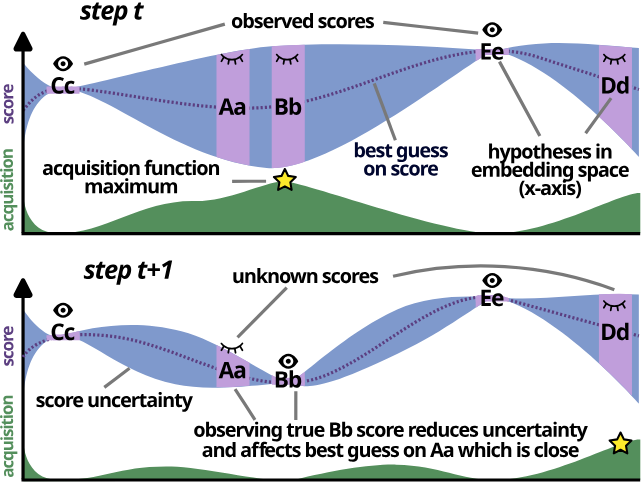
Reranking a list of candidates from a machine translation system with an external scoring model and returning the highest-scoring candidate remains a simple and effective method for improving the overall output quality. Translation scoring models continue to grow in size, with the best models being comparable to generation models. Thus, reranking can add substantial computational cost to the translation pipeline. In this work, we pose reranking as a Bayesian optimization (BayesOpt) problem. By strategically selecting candidates to score based on a balance of exploration and exploitation, we show that it is possible to find top-scoring candidates when scoring only a fraction of the candidate list. For instance, our method achieves the same CometKiwi score using only 70 scoring evaluations compared a baseline system using 180. We present a multi-fidelity setting for BayesOpt, where the candidates are first scored with a cheaper but noisier proxy scoring model, which further improves the cost-performance tradeoff when using smaller but well-trained distilled proxy scorers.
WMT24 General Machine Translation Shared Task: The LLM Era is Here but MT is Not Solved Yet
This overview paper presents the results of the General Machine Translation Task organised as part of the 2024 Conference on Machine Translation (WMT). In the general MT task, participants were asked to build machine translation systems for any of 11 language pairs, to be evaluated on test sets consisting of three to five different domains. In addition to participating systems, we collected translations from 8 different large language models (LLMs) and 4 online translation providers. We evaluate system outputs with professional human annotators using a new protocol called Error Span Annotations (ESA).
WMT 2023 Shared Task on Machine Translation with Terminologies
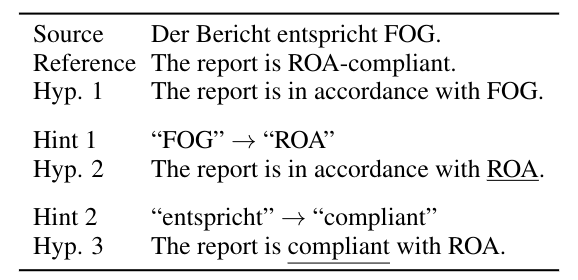
The WMT 2023 Terminology Shared Task investigates progress in machine translation of texts with specialized vocabulary. The participants were given the source text and segment-level terminology dictionaries for three language pairs: Chinese→English, English→Czech, and German→English. We evaluate 21 submissions from 7 teams on two main criteria: general translation quality and the effectiveness of translating specialized terminology. Systems took varied approaches — incorporating terminology at inference time or weakly supervised training that uses terminology access. While incorporating terminology dictionaries leads to improvement in the translation quality, incorporating an equal amount of information from the reference leads to similar results. This challenges the position of terminologies being the crux of meaning in translation, it can also be explained by inadequate metrics which are not terminology-centric.
Hurdles of Automatic Metric for Speech Translation Evaluation
Automatic evaluation of speech translation has so far relied on text-only automated metrics that ignore speech phenomena. One would expect that incorporating the source audio modality would improve the performance of automatic metrics. We implement two standard metric paradigms: a COMET-audio regression model using audio and text encoders, and one based on prompting a speech large language model. Surprisingly, both audio-infused models fail to reliably surpass text-only baselines. We attribute this failure to the noise pollution and audio-transcript mismatches present in the audio signal, which makes the modality unreliable from the metric’s perspective. Furthermore, we argue that current human-annotated evaluation datasets for automated metrics predominantly feature technical content or short texts where paralinguistic features like prosody lack importance, rendering the extra audio information unhelpful for quality estimation (QE).
Speech Translation and Metrics in 2026: Findings of the IWSLT Campaign
This paper reports on the outcomes of the shared tasks organized as part of the 23rd International Workshop on Spoken Language Translation (IWSLT). The workshop covered ten major challenges in spoken language translation, including speech-to-text translation for both high-resource and low-resource language pairs, customized speech translation, speech generation, instruction-following speech processing, and the evaluation of speech translation systems. The shared tasks received strong participation, with more than 30 teams submitting runs. This year’s edition broadened the range of tasks, placing particular emphasis on speech generation and evaluation metrics.
Findings of the IWSLT 2025 Evaluation Campaign
This paper presents the outcomes of the shared tasks conducted at the 22nd International Workshop on Spoken Language Translation (IWSLT). The workshop addressed seven critical challenges in spoken language translation: simultaneous and offline translation, automatic subtitling and dubbing, model compression, speech-to-speech translation, dialect and low-resource speech translation, and Indic languages. The shared tasks garnered significant participation, with 32 teams submitting their runs. The field’s growing importance is reflected in the increasing diversity of shared task organizers and contributors to this overview paper, representing a balanced mix of industrial and academic institutions. This broad participation demonstrates the rising prominence of spoken language translation in both research and practical applications.
Are Large Language Models for Education Reliable for All Languages?
Large language models (LLMs) are increasingly being adopted in educational settings. These applications expand beyond English, though current LLMs remain primarily English-centric. In this work, we ascertain if their use in education settings in non-English languages is warranted. We evaluated the performance of popular LLMs on four educational tasks: identifying student misconceptions, providing targeted feedback, interactive tutoring, and grading translations in eight languages (Mandarin, Hindi, Arabic, German, Farsi, Telugu, Ukrainian, Czech) in addition to English. We find that the performance on these tasks somewhat corresponds to the amount of language represented in training data, with lower-resource languages having poorer task performance. However, at least some models are able to more or less maintain their levels of performance across all languages. Thus, we recommend that practitioners first verify that the LLM works well in the target language for their educational task before deployment.
Understanding Large Language Model Behaviors Through Interactive Counterfactual Generation and Analysis
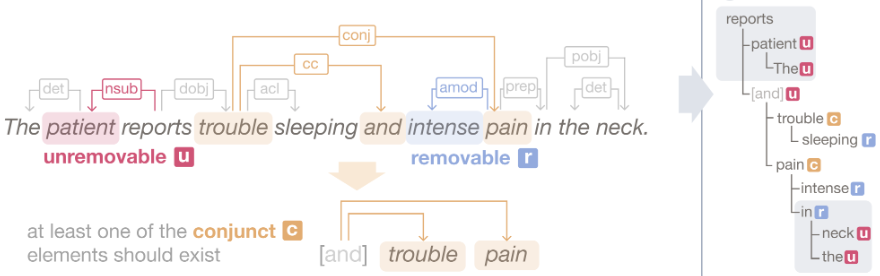
Counterfactual examples are useful for exploring the decision boundaries of machine learning models and determining feature attributions. How can we apply counterfactual-based methods to analyze and explain LLMs? We identify the following key challenges. First, the generated textual counterfactuals should be meaningful and readable to users and thus can be mentally compared to draw conclusions. Second, to make the solution scalable to long-form text, users should be equipped with tools to create batches of counterfactuals from perturbations at various granularity levels and interactively analyze the results. In this paper, we tackle the above challenges and contribute 1) a novel algorithm for generating batches of complete and meaningful textual counterfactuals by removing and replacing text segments in different granularities, and 2) LLM Analyzer, an interactive visualization tool to help users understand an LLM's behaviors by interactively inspecting and aggregating meaningful counterfactuals. We evaluate the proposed algorithm by the grammatical correctness of its generated counterfactuals using 1,000 samples from medical, legal, finance, education, and news datasets. In our experiments, 97.2% of the counterfactuals are grammatically correct. Through a use case, user studies, and feedback from experts, we demonstrate the usefulness and usability of the proposed interactive visualization tool.
PWESuite: Phonetic Word Embeddings and Tasks They Facilitate
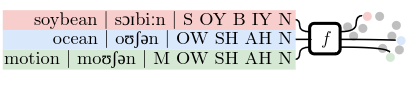
Word embeddings that map words into a fixed-dimensional vector space are the backbone of modern NLP. Most word embedding methods encode semantic information. However, phonetic information, which is important for some tasks, is often overlooked. In this work, we develop several novel methods which leverage articulatory features to build phonetically informed word embeddings, and present a set of phonetic word embeddings to encourage their community development, evaluation and use. While several methods for learning phonetic word embeddings already exist, there is a lack of consistency in evaluating their effectiveness. Thus, we also proposes several ways to evaluate both intrinsic aspects of phonetic word embeddings, such as word retrieval and correlation with sound similarity, and extrinsic performances, such as rhyme and cognate detection and sound analogies. We hope that our suite of tasks will promote reproducibility and provide direction for future research on phonetic word embeddings.
Two Counterexamples to Tokenization and the Noiseless Channel
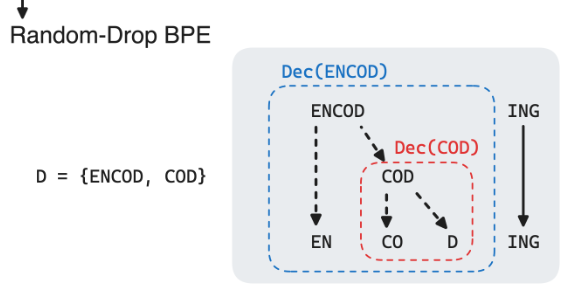
In Tokenization and the Noiseless Channel, Rényi efficiency is suggested as an intrinsic mechanism for evaluating a tokenizer: for NLP tasks, the tokenizer which leads to the highest Rényi efficiency of the unigram distribution should be chosen. The Rényi efficiency is thus treated as a predictor of downstream performance (e.g., predicting BLEU for machine translation task), without the expensive step of training multiple models with different tokenizers. Although useful, the predictive power of this metric is not perfect, and the authors note there are additional qualities of a good tokenization scheme that Rényi efficiency alone cannot capture. We describe two variants of BPE tokenization which can arbitrarily increase Rényi efficiency while decreasing the downstream model performance. These counterexamples expose cases where Rényi efficiency fails as an intrinsic tokenization metric and thus give insight for building more accurate predictors.
How to Engage Your Readers? Generating Guiding Questions to Promote Active Reading
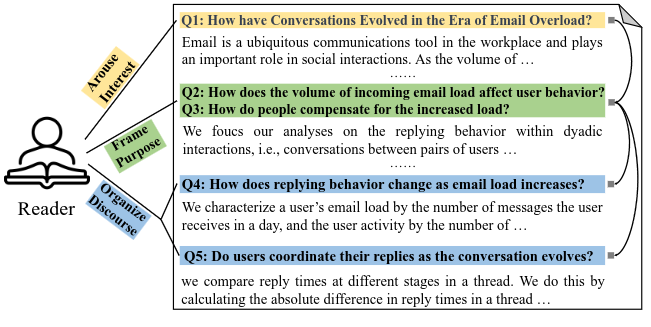
Using questions in written text is an effective strategy to enhance readability. However, what makes an active reading question good, what the linguistic role of these questions is, and what is their impact on human reading remains understudied. We introduce GuidingQ, a dataset of 10K in-text questions from textbooks and scientific articles. By analyzing the dataset, we present a comprehensive understanding of the use, distribution, and linguistic characteristics of these questions. Then, we explore various approaches to generate such questions using language models. Our results highlight the importance of capturing inter-question relationships and the challenge of question position identification in generating these questions. Finally, we conduct a human study to understand the implication of such questions on reading comprehension. We find that the generated questions are of high quality and are almost as effective as human-written questions in terms of improving readers' memorization and comprehension.
AutoTutor meets Large Language Models: A Language Model Tutor with Rich Pedagogy and Guardrails
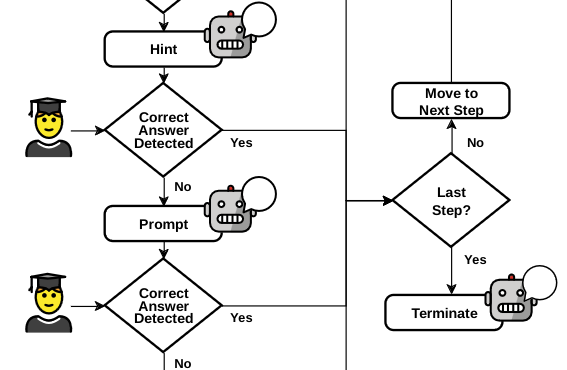
Large Language Models (LLMs) have found several use cases in education, ranging from automatic question generation to essay evaluation. In this paper, we explore the potential of using LLMs to author Intelligent Tutoring Systems. A common pitfall of using LLMs as tutors is their straying from desired pedagogical strategies such as leaking the answer to the student, and in general, providing no guarantees on the validity or appropriateness of the tutor assistance. We argue that while LLMs with certain guardrails can take the place of subject experts, the overall pedagogical design still needs to be handcrafted for the best learning results. Based on this principle, we create a sample end-to-end tutoring system named MWPTutor, which uses LLMs to fill in the state space of a predefined finite state transducer. This approach retains the structure and the pedagogy of traditional tutoring systems that has been developed over the years by learning scientists but brings in additional flexibility of LLM-based approaches. Through a human evaluation study on two datasets with math word problems, we show that our hybrid approach achieves a better overall tutoring score than an instructed, but otherwise free-form, GPT-4. MWPTutor is completely modular and opens up the scope for the community to improve its performance by refining its individual modules or using different teaching strategies that it can follow.
Enhancing Textbooks with Visuals from the Web for Improved Learning
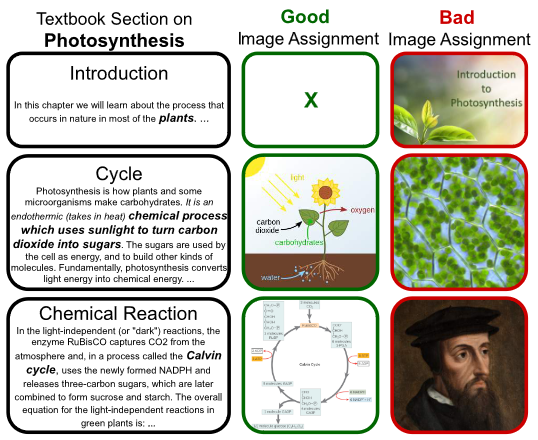
Textbooks are one of the main mediums for delivering high-quality education to students. In particular, explanatory and illustrative visuals play a key role in retention, comprehension and general transfer of knowledge. However, many textbooks lack these interesting visuals to support student learning. In this paper, we investigate the effectiveness of vision-language models to automatically enhance textbooks with images from the web. We collect a dataset of e-textbooks in the math, science, social science and business domains. We then set up a text-image matching task that involves retrieving and appropriately assigning web images to textbooks, which we frame as a matching optimization problem. Through a crowd-sourced evaluation, we verify that (1) while the original textbook images are rated higher, automatically assigned ones are not far behind, and (2) the precise formulation of the optimization problem matters. We release the dataset of textbooks with an associated image bank to inspire further research in this intersectional area of computer vision and NLP for education.
Shrinking Knowledge Base Size: Dimension Reduction, Splitting & Filtering
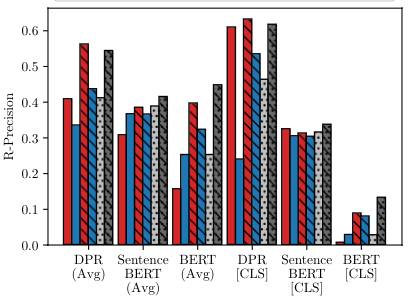
ecently neural network based approaches to knowledge-intensive NLP tasks, such asquestion answering, started to rely heavily on the combination of neural retrievers andreaders. Retrieval is typically performed over a large textual knowledge base whichrequires significant memory and compute resources, especially when scaled up. OnHotpotQA we explore various filtering & splitting criteria. Primarily, we systematicallyinvestigate reducing the size of the KB index by means of dimensionality (sparse randomprojections, PCA, autoencoders) and numerical precision reduction.Our results show that PCA is an easy solution that requires very little data and is onlyslightly worse than autoencoders, which are less stable. All methods are sensitive to pre-and post-processing and data should always be centered and normalized both before andafter dimension reduction. Finally, we show that it is possible to combine PCA withusing 1bit per dimension. Overall we achieve (1) 100× compression with 75%, and (2)24× compression with 92% original retrieval performance.